The James Webb Space Telescope (JWST) has given astronomers and scientists a new perspective on life beyond Earth. NASA confirmed in a recent release that the telescope had identified possible signs of life emanating from K2-18 b, an Earth-like exoplanet that is 8.6 times the mass of our planet.
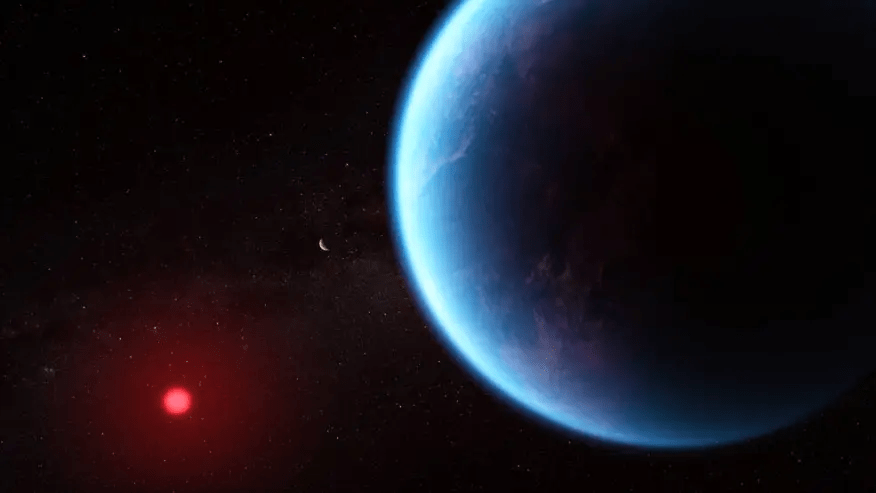
The Enigmatic K2-18 b
K2-18 b is not just another exoplanet in the vast universe; it lies 120 light-years from Earth in the constellation Leo. This celestial body orbits in what is known as the “habitable zone” of its host star, a cooler dwarf star named K2-18. The planet is categorized as a “Mini-Neptune,” which presents a particular enigma for astronomers because it does not resemble any planetary bodies in our solar system.
Intriguing Observations
What makes the recent JWST investigation so remarkable are the findings related to the composition of K2-18 b’s atmosphere. Researchers found “carbon-bearing molecules,” including methane and carbon dioxide. Such discoveries are significant because they add weight to the theory that K2-18 b could be a Hycean exoplanet with a hydrogen-rich atmosphere and potentially a water-covered surface.
The James Webb Space Telescope’s observations go beyond confirming existing theories. NASA reported the possible detection of a molecule known as dimethyl sulfide (DMS). Only life on Earth can produce this molecule, and phytoplankton in marine environments is where most of the DMS in Earth’s atmosphere comes from.
Changing the Narrative
It was just in 2019 that NASA’s Hubble Space Telescope first investigated K2-18’s atmosphere, and those initial studies already had significant implications. “Our findings underscore the importance of considering diverse habitable environments in the search for life elsewhere,” stated Nikku Madhusudhan, the lead author of the paper announcing these new results and an astronomer at the University of Cambridge.
Looking Ahead
According to team member Savvas Constantinou, also of the University of Cambridge, the discoveries are based on just two observations of K2-18 b. “This means our work here is but an early demonstration of what Webb can observe in habitable-zone exoplanets,” he explained. As the James Webb Space Telescope continues to peer into the far reaches of space, scientists hope for more insights that could fundamentally reshape our understanding of life beyond Earth.
Conclusion
The recent findings about K2-18 b create a ripple effect in the scientific community. While the search for life in the universe has always been a subject of interest, discoveries like these reignite the conversation and fuel the imagination. If nothing else, the observations made by the JWST highlight the vast possibilities that await us in the unexplored corners of our universe.
Cited Works:
Shannon, Bill. “James Webb Telescope Stumbles Upon Signs of Possible Life on an Earth-like Planet.” NewsNation, September 13, 2023. https://www.newsnationnow.com/space/james-webb-telescope-stumbles-onto-signs-of-possible-life-on-earth-like-planet/?fbclid=IwAR16ML0LF0PFDduPnJYtS6opGujHoFXUAszne7S1SYvvMST5bsaEFyLgv2c.
 The Dantzler Report!